
A Faith That Does Not Shrink Back
A Faith That Does Not Shrink Back
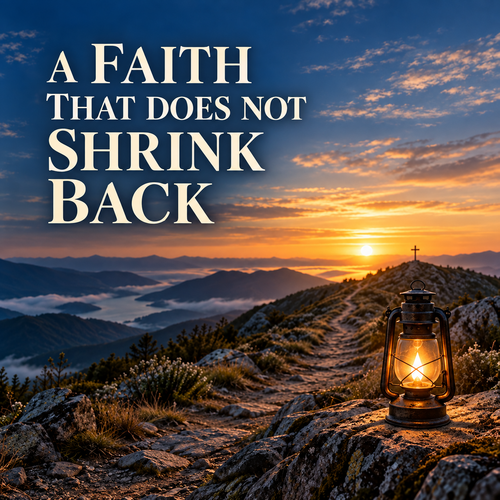
Photo Source: Artificially Generated
Note: If you have any questions about this topic or any of Pastor John's blog articles, feel free to contact him directly at pastor.john@fbcmoriarty.org, or you may contact the church office at office@fbcmoriarty.org.
Most of us know what it is like to feel confident about following Christ in one setting and hesitant in another. It may be easy to speak about our faith at church, but much harder around a skeptical coworker. We may genuinely want to help someone who is struggling but hesitate because getting involved could become complicated. We may know that we need to forgive, speak the truth, serve, or share the gospel, yet fear begins asking, “What will this cost me? What if they reject me? What if this becomes uncomfortable?”
It seems that Timothy knew something about that struggle.
Paul wrote to him at a time when following Christ had become costly. Paul was imprisoned because he preached the gospel, believers were facing growing opposition, and Timothy carried the weight of ministry in a difficult setting. The temptation to become quieter, safer, and less visible would have been very real. Paul therefore wrote:
“I recall your sincere faith that first lived in your grandmother Lois and in your mother Eunice and now, I am convinced, is in you also. Therefore, I remind you to rekindle the gift of God that is in you through the laying on of my hands. For God has not given us a spirit of fear, but one of power, love, and sound judgment.”
—2 Timothy 1:5–7
Paul did not begin by criticizing Timothy or telling him to toughen up. He began by reminding him of what was already true.
A Faith That Is Truly Your Own
Paul first reminded Timothy of his “sincere faith.” The word sincere speaks of something genuine—something real rather than performed for the benefit of others. Timothy’s faith was not merely a role he played in public. It was a genuine trust in Jesus Christ. Timothy had seen that kind of faith modeled at home. His grandmother Lois and his mother Eunice had apparently taught him the Scriptures and shown him what it looked like to trust God in everyday life. Their example was a wonderful gift. Many of us can look back and remember a parent, grandparent, Sunday school teacher, pastor, or faithful church member who showed us what genuine Christianity looked like. We remember hearing them pray, watching them open their Bibles, seeing them endure hardship, or noticing how they treated people when no one reward was expected.
Those examples matter. God often uses one generation's faithfulness to point the next generation toward Christ. Parents and grandparents can play a role in that regard-- training a child in the way they should go. But Timothy could not live forever on his grandmother’s faith or his mother’s faith. Their trust in Christ could instruct, encourage, and influence him, but it could not replace his own personal faith in Jesus.
The same is true for us today. We may have grown up in church. We may know the hymns, understand the language, and be able to tell familiar Bible stories. Our parents may have loved the Lord, and our family may have been part of the same church for generations. Those are meaningful blessings, but none of them can substitute for personally repenting of sin and trusting in Christ. Every person must come to Christ personally.
Paul was convinced that the same sincere faith that had lived in Lois and Eunice now lived in Timothy. Timothy had not merely adopted the family’s religious habits; he had come to trust the Savior they trusted. That genuine faith became the foundation for the courageous and consistent life Paul was calling him to live. And the need for this type of sincere faith has not changed since Paul wrote to Timothy. Bold Christian living does not grow out of inherited tradition, family reputation, or outward religious appearance. It grows out of genuine faith in Jesus Christ.
Stir the Fire Again
Because sincere faith lived in Timothy, Paul told him to “rekindle the gift of God.” I think that picture is easy to understand. A fire that is not tended begins to die down. The fire may not go completely out, but the flames become smaller, the light grows dimmer, and the heat fades. Someone must stir the coals and feed the fire so that it burns brightly again. The word rekindle can mean revitalize, which for a fire, is like causing it to begin again.
Paul was not necessarily accusing Timothy of abandoning Christ or walking away from his calling. The fire was still there. But fear, discouragement, and opposition threatened to weaken his faithfulness. Timothy may have been tempted to speak less boldly, take fewer risks, avoid difficult people, or remain silent when faithfulness required him to speak.
We face similar temptations today. We may not openly deny Christ, but we can gradually become quieter about Him in front of others. We can stop looking for opportunities to share the gospel because we assume people will not listen to us. We sometimes avoid a difficult conversation because we don't want the tension, or we fear rejection. We see someone carrying a heavy burden, but keep our distance because helping might require more time than we want to give. We know God has given us an opportunity to serve, teach, encourage, or lead, but insecurity persuades us to remain safely on the sidelines.
Fear of people and circumstances rarely announces, “I am going to make you unfaithful.” It usually sounds more reasonable than that. It tells us to rationalize our choices: wait until the timing is better, until we feel more confident, until the situation is less awkward, or until someone else takes responsibility.
Paul reminded Timothy that what God had entrusted to him must not be neglected simply because obedience had become uncomfortable. Timothy did not need to wait until every nervous feeling disappeared. He needed to act faithfully with the strength God provided. The same is true for us. There are times when we must obey while our hands are still trembling. Courage is not the absence of fear. Courage is trusting God enough to obey Him even when fear is present.
Power, Love, and Sound Judgment - By His Holy Spirit
Paul then reminded Timothy of what God had given him: “power, love, and sound judgment.” These three belong together.
By His Holy Spirit, God gives His people power so that they can act when obedience is difficult. This is not the power to dominate people, win every argument, or prove that we are right. It is the strength to remain faithful when silence would be easier. It is the strength to speak about Christ, resist temptation, endure criticism, forgive an offender, serve without recognition, and continue doing good when we are tired.
By His Holy Spirit, God also gives His people love. Love directs our strength toward God’s glory and the good of others. Christian courage is never an excuse to become harsh, rude, or careless. We do not speak the truth because we enjoy confrontation. We speak because truth matters and because people matter. We do not confront sin to embarrass someone but because sin destroys people made in God’s image. We do not share the gospel to win an argument but because people need the Savior.
By His Holy Spirit, God also gives sound judgment—the ability to think clearly, exercise self-control, and respond wisely. Courage does not mean saying everything that enters our minds. It does not mean charging recklessly into every disagreement. Sound judgment asks not only, “Is this true?” but also, “Is this the right time, the right tone, and the right way to say it?” It enables us to be courageous without becoming careless.
Power without love becomes harshness. Love without power can become timid sentimentality. Boldness without sound judgment becomes reckless and destructive. God gives us power to act, love to guide our actions, and sound judgment to act wisely.
Love Is Not Passive
This kind of love is not merely a warm feeling. It moves toward people and seeks their good.
Fear says, “Protect yourself.” Love says, “Give yourself for the good of another.”
Fear says, “Do not mention Christ; they may think differently of you.” Love says, “They need to hear the good news.”
Fear says, “Do not get involved; their problems may become your problems.” Love says, “I will not leave you to carry this burden alone.”
Fear says, “Hold on to that resentment so you do not get hurt again.” Love says, “Because Christ has forgiven me, I will pursue forgiveness and peace.”
Fear says, “Someone else will serve.” Love asks, “What can I do?”
Bold love may look dramatic, but it often appears in ordinary moments. It may mean making the phone call you have been postponing, sitting with someone who is grieving, welcoming a person who feels forgotten, admitting that you were wrong, sharing the gospel with a friend, or lovingly confronting someone who is wandering into sin. It may mean serving when no one notices or remaining beside someone whose struggles cannot be solved in a single conversation.
Bold love is willing to get involved and even become uncomfortable for the spiritual and practical good of another person.
Jesus is the supreme demonstration of this love. He did not love us from a safe distance. He came near to sinners. He spoke the truth, showed compassion, touched the unclean, welcomed the rejected, and moved toward people others avoided. Ultimately, He gave himself on the cross, bearing the guilt and judgment our sins deserved so that everyone who repents and believes in Him may be forgiven and reconciled to God.
Christ’s love was neither fearful nor passive. It was courageous, sacrificial, and obedient to the Father. Because He has loved us in this way, we must not allow fear to silence our devotion to Him or restrain our love for others.
From One Courageous Moment to a Consistent Life
This is where, however, I must say that one courageous moment is not the same as a consistent Christian life.
A person may speak boldly today and retreat tomorrow. We can leave a worship service stirred up and moved, make strong promises to God, and then return to familiar habits by the middle of the week. We may have moments when our faith seems to burn brightly, followed by seasons when the fire feels weak.
Timothy was not being called merely to make one brave decision. He was being called to continue faithfully (to be consistent) in what God had entrusted to him. Rekindling the gift was not about creating a brief emotional high. Timothy needed to keep on trusting Christ, keep on exercising his gift, and keep on obeying even when ministry was difficult.
This is where bold love and consistency in the Christian life meet: bold love takes the faithful step before us, and consistency keeps taking that step day after day.
Consistency does not mean that we never struggle, doubt, grow tired, or stumble into sin. It does not mean waking up every morning with the same emotions or spiritual enthusiasm. Consistency means continuing to trust and obey Christ when our feelings, circumstances, and temptations pull us in another direction.
A consistent Christian is not a perfect Christian. A consistent Christian is someone whose life has a settled direction—someone who repeatedly returns to Christ, refuses to make peace with sin, and continues taking the next faithful step.
Depend on God’s Power, Not Your Willpower
We often respond to inconsistency by making stronger promises to ourselves: “This time I will try harder. This time I will be more disciplined. This time I will not fail.” There is certainly a place for discipline and determination, but Paul did not tell Timothy to overcome fear through a stronger personality. He reminded Timothy of what God had supplied. The Christian life is not sustained by being tougher or by willpower alone. We need the power God provides.
That means we begin each day recognizing our dependence upon Him. We pray for His strength before entering the difficult conversation. We ask for Spirit-led patience before responding to the person who frustrates us. We seek His help when temptation returns. We confess that we are not naturally strong enough to remain faithful on our own.
Our confidence is not that we are unusually strong people. Our confidence is that God is faithful and provides what His people need to obey Him.
Remain in God’s Word
Consistency also requires remaining in God’s Word. Jesus said, “If you continue in my word, you really are my disciples” (John 8:31). We cannot remain spiritually steady while neglecting the truth that directs, corrects, and strengthens us. Our feelings change. Circumstances shift. The opinions around us constantly compete for our attention. Temptation tells us that disobedience will satisfy us and that obedience will cost too much. God’s Word cuts through those lies and reminds us of what is true.
This does not mean we must read several chapters every morning before sunrise to prove that we are serious Christians. It means that Scripture must have a regular and meaningful place in our lives. Read a passage carefully. Think about what it reveals about God. Ask what it exposes in your heart. Consider what obedience requires. Carry its truth with you into the day.
A Bible that is occasionally admired but rarely opened will not anchor a life. Consistent faith requires consistent exposure to God’s truth.
Practice Ordinary Obedience
Most spiritual consistency is built through small, repeated choices-- by building habits of mind and intentionally choosing to put God first in our lives. We sometimes wait for a dramatic spiritual moment to change us, while overlooking the ordinary opportunities for obedience already in front of us. But faithfulness is often formed in places that seem unimpressive. It is formed when we pray even though we feel distracted, open God’s Word when we are tired, resist a familiar temptation, tell the truth when a lie would be convenient, forgive someone who has hurt us, show up to worship, serve without applause, show up for bible study when sleeping in would be easier, and keep a commitment even though quitting would be much easier.
No single act may feel especially dramatic, but each one points our lives in a direction. Over time, repeated obedience forms patterns of faithfulness. A long life of consistency and faithfulness in the Christian walk is usually made up of thousands of ordinary decisions to trust Christ and keep on doing what He says in His Word.
Stay Close to Christ
Jesus said, “Remain in me, and I in you” (John 15:4). A branch does not produce fruit by straining harder. It bears fruit by remaining connected to the vine. In the same way, we cannot manufacture spiritual fruit through human effort. Consistency is not about learning to function independently of Christ. It is about learning to depend upon Him continually. We remain in Christ by trusting His promises, receiving His grace, obeying His commands, and looking to Him for strength. When we are discouraged, we return to Christ. When we are tempted, we return to Christ. When we succeed, we give thanks to Christ. When we sin, we confess it and return to Christ.
The Christian life begins by trusting Christ, continues by trusting Christ, and ends with our hope fixed upon Christ.
Walk with God’s People
God has also given us the church to help us remain consistent and faithful. Hebrews warns believers to watch their hearts and to “encourage each other daily” so that no one becomes hardened by sin’s deception (Hebrews 3:12–13).
Sin is deceitful. It rarely presents itself honestly. It convinces us that compromise is harmless, isolation is safer, resentment is justified, and repentance can wait. That is one reason we need other believers. We need people who know us well enough to notice when something is changing. We need Christians who will encourage us when we are weary, pray for us when we are struggling, confront us when we begin to wander, and remind us of the gospel when shame tells us to hide. We also need to become that kind of person for someone else. Isolated Christians rarely remain steady Christians. God did not design us to follow Christ alone.
Repent Quickly When You Sin
Consistency does not mean pretending that we never fail. It means refusing to become comfortable with sin. When we sin, our instinct may be to hide, excuse ourselves, blame someone else, or avoid God until we feel less ashamed. But the longer we protect our sin, the more room we give it to harden our hearts. Consistent Christians learn to repent quickly.
First John 1:9 assures us, “If we confess our sins, he is faithful and righteous to forgive us our sins and to cleanse us from all unrighteousness.” Because Christ has paid for our sins, we can confess them honestly. We do not have to minimize what we have done or hide behind religious appearances. We can bring our sin into the light, receive Christ’s forgiveness, and return to obedience.
A consistent Christian is not someone who never falls. It is someone who keeps returning to Christ in repentance and faith.
Our Confidence Is in Christ
Ultimately, our hope does not rest in our ability to hold everything together. It rests in the faithfulness and consistency of Christ. Later in the same chapter, Paul explained why he could continue despite suffering: “I know whom I have believed and am persuaded that he is able to guard what has been entrusted to me until that day” (2 Timothy 1:12).
I hope you believe the same. Notice that Paul did not merely say, “I know what I believe.” He said, “I know whom I have believed.” His confidence was personal. He trusted the character, power, and faithfulness of Jesus Christ.
That is our confidence as well. We persevere because Christ holds His people. He supplies what we need. He forgives us when we confess our sins. He completes the work He begins. Our grip may sometimes feel weak, but our Savior is not weak.
We become consistent in the faith by repeatedly returning to Christ—trusting His power, remaining in His Word, practicing ordinary obedience, walking with His people, and quickly repenting when we sin. The goal is not one dramatic spiritual experience but a life that keeps taking the next faithful step.
Paul wrote, “Let us not get tired of doing good, for we will reap at the proper time if we don’t give up” (Galatians 6:9).
So ask yourself: Where has fear caused me to remain silent, withdraw, or protect myself? Where am I tempted to grow weary and stop obeying? What faithful step has God already placed in front of me?
God has not given His people a spirit of fear. He has given us power, love, and sound judgment. Therefore, let us boldly love God, sacrificially love others, and consistently take the next faithful step with Christ.
Keep Taking the Next Faithful Step
The Christian life is not lived in one great moment of courage. It is lived through daily decisions to trust Christ when fear tells us to retreat, to love when self-protection seems easier, and to obey when giving up feels more comfortable. Some of those decisions will be seen by others, but many will not. They will happen in quiet prayers, difficult conversations, unseen acts of service, resisted temptations, and honest moments of repentance.
Perhaps the fire of your faith does not feel as bright as it once did. That does not mean God is finished with you. Return to His Word. Draw near to Christ. Pray and ask for His strength. Reconnect with His people. Confess whatever sin you have allowed to remain. Then take the next step of obedience God has already placed before you.
You do not have to know everything that lies ahead. You do not have to feel fearless before you obey. You simply need to trust the Savior who has promised to remain with you. The same Christ who calls you to faithfulness will provide the power, love, and sound judgment you need.
So do not shrink back. Rekindle what fear may have allowed to grow dim. Love God openly, love others courageously, and keep returning to Christ in all things. A consistent Christian life is built one faithful step at a time—and by His grace, Christ will give you strength to take the next one—and in doing do, may the Lord bless you as you seek to honor Him.
It seems that Timothy knew something about that struggle.
Paul wrote to him at a time when following Christ had become costly. Paul was imprisoned because he preached the gospel, believers were facing growing opposition, and Timothy carried the weight of ministry in a difficult setting. The temptation to become quieter, safer, and less visible would have been very real. Paul therefore wrote:
“I recall your sincere faith that first lived in your grandmother Lois and in your mother Eunice and now, I am convinced, is in you also. Therefore, I remind you to rekindle the gift of God that is in you through the laying on of my hands. For God has not given us a spirit of fear, but one of power, love, and sound judgment.”
—2 Timothy 1:5–7
Paul did not begin by criticizing Timothy or telling him to toughen up. He began by reminding him of what was already true.
A Faith That Is Truly Your Own
Paul first reminded Timothy of his “sincere faith.” The word sincere speaks of something genuine—something real rather than performed for the benefit of others. Timothy’s faith was not merely a role he played in public. It was a genuine trust in Jesus Christ. Timothy had seen that kind of faith modeled at home. His grandmother Lois and his mother Eunice had apparently taught him the Scriptures and shown him what it looked like to trust God in everyday life. Their example was a wonderful gift. Many of us can look back and remember a parent, grandparent, Sunday school teacher, pastor, or faithful church member who showed us what genuine Christianity looked like. We remember hearing them pray, watching them open their Bibles, seeing them endure hardship, or noticing how they treated people when no one reward was expected.
Those examples matter. God often uses one generation's faithfulness to point the next generation toward Christ. Parents and grandparents can play a role in that regard-- training a child in the way they should go. But Timothy could not live forever on his grandmother’s faith or his mother’s faith. Their trust in Christ could instruct, encourage, and influence him, but it could not replace his own personal faith in Jesus.
The same is true for us today. We may have grown up in church. We may know the hymns, understand the language, and be able to tell familiar Bible stories. Our parents may have loved the Lord, and our family may have been part of the same church for generations. Those are meaningful blessings, but none of them can substitute for personally repenting of sin and trusting in Christ. Every person must come to Christ personally.
Paul was convinced that the same sincere faith that had lived in Lois and Eunice now lived in Timothy. Timothy had not merely adopted the family’s religious habits; he had come to trust the Savior they trusted. That genuine faith became the foundation for the courageous and consistent life Paul was calling him to live. And the need for this type of sincere faith has not changed since Paul wrote to Timothy. Bold Christian living does not grow out of inherited tradition, family reputation, or outward religious appearance. It grows out of genuine faith in Jesus Christ.
Stir the Fire Again
Because sincere faith lived in Timothy, Paul told him to “rekindle the gift of God.” I think that picture is easy to understand. A fire that is not tended begins to die down. The fire may not go completely out, but the flames become smaller, the light grows dimmer, and the heat fades. Someone must stir the coals and feed the fire so that it burns brightly again. The word rekindle can mean revitalize, which for a fire, is like causing it to begin again.
Paul was not necessarily accusing Timothy of abandoning Christ or walking away from his calling. The fire was still there. But fear, discouragement, and opposition threatened to weaken his faithfulness. Timothy may have been tempted to speak less boldly, take fewer risks, avoid difficult people, or remain silent when faithfulness required him to speak.
We face similar temptations today. We may not openly deny Christ, but we can gradually become quieter about Him in front of others. We can stop looking for opportunities to share the gospel because we assume people will not listen to us. We sometimes avoid a difficult conversation because we don't want the tension, or we fear rejection. We see someone carrying a heavy burden, but keep our distance because helping might require more time than we want to give. We know God has given us an opportunity to serve, teach, encourage, or lead, but insecurity persuades us to remain safely on the sidelines.
Fear of people and circumstances rarely announces, “I am going to make you unfaithful.” It usually sounds more reasonable than that. It tells us to rationalize our choices: wait until the timing is better, until we feel more confident, until the situation is less awkward, or until someone else takes responsibility.
Paul reminded Timothy that what God had entrusted to him must not be neglected simply because obedience had become uncomfortable. Timothy did not need to wait until every nervous feeling disappeared. He needed to act faithfully with the strength God provided. The same is true for us. There are times when we must obey while our hands are still trembling. Courage is not the absence of fear. Courage is trusting God enough to obey Him even when fear is present.
Power, Love, and Sound Judgment - By His Holy Spirit
Paul then reminded Timothy of what God had given him: “power, love, and sound judgment.” These three belong together.
By His Holy Spirit, God gives His people power so that they can act when obedience is difficult. This is not the power to dominate people, win every argument, or prove that we are right. It is the strength to remain faithful when silence would be easier. It is the strength to speak about Christ, resist temptation, endure criticism, forgive an offender, serve without recognition, and continue doing good when we are tired.
By His Holy Spirit, God also gives His people love. Love directs our strength toward God’s glory and the good of others. Christian courage is never an excuse to become harsh, rude, or careless. We do not speak the truth because we enjoy confrontation. We speak because truth matters and because people matter. We do not confront sin to embarrass someone but because sin destroys people made in God’s image. We do not share the gospel to win an argument but because people need the Savior.
By His Holy Spirit, God also gives sound judgment—the ability to think clearly, exercise self-control, and respond wisely. Courage does not mean saying everything that enters our minds. It does not mean charging recklessly into every disagreement. Sound judgment asks not only, “Is this true?” but also, “Is this the right time, the right tone, and the right way to say it?” It enables us to be courageous without becoming careless.
Power without love becomes harshness. Love without power can become timid sentimentality. Boldness without sound judgment becomes reckless and destructive. God gives us power to act, love to guide our actions, and sound judgment to act wisely.
Love Is Not Passive
This kind of love is not merely a warm feeling. It moves toward people and seeks their good.
Fear says, “Protect yourself.” Love says, “Give yourself for the good of another.”
Fear says, “Do not mention Christ; they may think differently of you.” Love says, “They need to hear the good news.”
Fear says, “Do not get involved; their problems may become your problems.” Love says, “I will not leave you to carry this burden alone.”
Fear says, “Hold on to that resentment so you do not get hurt again.” Love says, “Because Christ has forgiven me, I will pursue forgiveness and peace.”
Fear says, “Someone else will serve.” Love asks, “What can I do?”
Bold love may look dramatic, but it often appears in ordinary moments. It may mean making the phone call you have been postponing, sitting with someone who is grieving, welcoming a person who feels forgotten, admitting that you were wrong, sharing the gospel with a friend, or lovingly confronting someone who is wandering into sin. It may mean serving when no one notices or remaining beside someone whose struggles cannot be solved in a single conversation.
Bold love is willing to get involved and even become uncomfortable for the spiritual and practical good of another person.
Jesus is the supreme demonstration of this love. He did not love us from a safe distance. He came near to sinners. He spoke the truth, showed compassion, touched the unclean, welcomed the rejected, and moved toward people others avoided. Ultimately, He gave himself on the cross, bearing the guilt and judgment our sins deserved so that everyone who repents and believes in Him may be forgiven and reconciled to God.
Christ’s love was neither fearful nor passive. It was courageous, sacrificial, and obedient to the Father. Because He has loved us in this way, we must not allow fear to silence our devotion to Him or restrain our love for others.
From One Courageous Moment to a Consistent Life
This is where, however, I must say that one courageous moment is not the same as a consistent Christian life.
A person may speak boldly today and retreat tomorrow. We can leave a worship service stirred up and moved, make strong promises to God, and then return to familiar habits by the middle of the week. We may have moments when our faith seems to burn brightly, followed by seasons when the fire feels weak.
Timothy was not being called merely to make one brave decision. He was being called to continue faithfully (to be consistent) in what God had entrusted to him. Rekindling the gift was not about creating a brief emotional high. Timothy needed to keep on trusting Christ, keep on exercising his gift, and keep on obeying even when ministry was difficult.
This is where bold love and consistency in the Christian life meet: bold love takes the faithful step before us, and consistency keeps taking that step day after day.
Consistency does not mean that we never struggle, doubt, grow tired, or stumble into sin. It does not mean waking up every morning with the same emotions or spiritual enthusiasm. Consistency means continuing to trust and obey Christ when our feelings, circumstances, and temptations pull us in another direction.
A consistent Christian is not a perfect Christian. A consistent Christian is someone whose life has a settled direction—someone who repeatedly returns to Christ, refuses to make peace with sin, and continues taking the next faithful step.
Depend on God’s Power, Not Your Willpower
We often respond to inconsistency by making stronger promises to ourselves: “This time I will try harder. This time I will be more disciplined. This time I will not fail.” There is certainly a place for discipline and determination, but Paul did not tell Timothy to overcome fear through a stronger personality. He reminded Timothy of what God had supplied. The Christian life is not sustained by being tougher or by willpower alone. We need the power God provides.
That means we begin each day recognizing our dependence upon Him. We pray for His strength before entering the difficult conversation. We ask for Spirit-led patience before responding to the person who frustrates us. We seek His help when temptation returns. We confess that we are not naturally strong enough to remain faithful on our own.
Our confidence is not that we are unusually strong people. Our confidence is that God is faithful and provides what His people need to obey Him.
Remain in God’s Word
Consistency also requires remaining in God’s Word. Jesus said, “If you continue in my word, you really are my disciples” (John 8:31). We cannot remain spiritually steady while neglecting the truth that directs, corrects, and strengthens us. Our feelings change. Circumstances shift. The opinions around us constantly compete for our attention. Temptation tells us that disobedience will satisfy us and that obedience will cost too much. God’s Word cuts through those lies and reminds us of what is true.
This does not mean we must read several chapters every morning before sunrise to prove that we are serious Christians. It means that Scripture must have a regular and meaningful place in our lives. Read a passage carefully. Think about what it reveals about God. Ask what it exposes in your heart. Consider what obedience requires. Carry its truth with you into the day.
A Bible that is occasionally admired but rarely opened will not anchor a life. Consistent faith requires consistent exposure to God’s truth.
Practice Ordinary Obedience
Most spiritual consistency is built through small, repeated choices-- by building habits of mind and intentionally choosing to put God first in our lives. We sometimes wait for a dramatic spiritual moment to change us, while overlooking the ordinary opportunities for obedience already in front of us. But faithfulness is often formed in places that seem unimpressive. It is formed when we pray even though we feel distracted, open God’s Word when we are tired, resist a familiar temptation, tell the truth when a lie would be convenient, forgive someone who has hurt us, show up to worship, serve without applause, show up for bible study when sleeping in would be easier, and keep a commitment even though quitting would be much easier.
No single act may feel especially dramatic, but each one points our lives in a direction. Over time, repeated obedience forms patterns of faithfulness. A long life of consistency and faithfulness in the Christian walk is usually made up of thousands of ordinary decisions to trust Christ and keep on doing what He says in His Word.
Stay Close to Christ
Jesus said, “Remain in me, and I in you” (John 15:4). A branch does not produce fruit by straining harder. It bears fruit by remaining connected to the vine. In the same way, we cannot manufacture spiritual fruit through human effort. Consistency is not about learning to function independently of Christ. It is about learning to depend upon Him continually. We remain in Christ by trusting His promises, receiving His grace, obeying His commands, and looking to Him for strength. When we are discouraged, we return to Christ. When we are tempted, we return to Christ. When we succeed, we give thanks to Christ. When we sin, we confess it and return to Christ.
The Christian life begins by trusting Christ, continues by trusting Christ, and ends with our hope fixed upon Christ.
Walk with God’s People
God has also given us the church to help us remain consistent and faithful. Hebrews warns believers to watch their hearts and to “encourage each other daily” so that no one becomes hardened by sin’s deception (Hebrews 3:12–13).
Sin is deceitful. It rarely presents itself honestly. It convinces us that compromise is harmless, isolation is safer, resentment is justified, and repentance can wait. That is one reason we need other believers. We need people who know us well enough to notice when something is changing. We need Christians who will encourage us when we are weary, pray for us when we are struggling, confront us when we begin to wander, and remind us of the gospel when shame tells us to hide. We also need to become that kind of person for someone else. Isolated Christians rarely remain steady Christians. God did not design us to follow Christ alone.
Repent Quickly When You Sin
Consistency does not mean pretending that we never fail. It means refusing to become comfortable with sin. When we sin, our instinct may be to hide, excuse ourselves, blame someone else, or avoid God until we feel less ashamed. But the longer we protect our sin, the more room we give it to harden our hearts. Consistent Christians learn to repent quickly.
First John 1:9 assures us, “If we confess our sins, he is faithful and righteous to forgive us our sins and to cleanse us from all unrighteousness.” Because Christ has paid for our sins, we can confess them honestly. We do not have to minimize what we have done or hide behind religious appearances. We can bring our sin into the light, receive Christ’s forgiveness, and return to obedience.
A consistent Christian is not someone who never falls. It is someone who keeps returning to Christ in repentance and faith.
Our Confidence Is in Christ
Ultimately, our hope does not rest in our ability to hold everything together. It rests in the faithfulness and consistency of Christ. Later in the same chapter, Paul explained why he could continue despite suffering: “I know whom I have believed and am persuaded that he is able to guard what has been entrusted to me until that day” (2 Timothy 1:12).
I hope you believe the same. Notice that Paul did not merely say, “I know what I believe.” He said, “I know whom I have believed.” His confidence was personal. He trusted the character, power, and faithfulness of Jesus Christ.
That is our confidence as well. We persevere because Christ holds His people. He supplies what we need. He forgives us when we confess our sins. He completes the work He begins. Our grip may sometimes feel weak, but our Savior is not weak.
We become consistent in the faith by repeatedly returning to Christ—trusting His power, remaining in His Word, practicing ordinary obedience, walking with His people, and quickly repenting when we sin. The goal is not one dramatic spiritual experience but a life that keeps taking the next faithful step.
Paul wrote, “Let us not get tired of doing good, for we will reap at the proper time if we don’t give up” (Galatians 6:9).
So ask yourself: Where has fear caused me to remain silent, withdraw, or protect myself? Where am I tempted to grow weary and stop obeying? What faithful step has God already placed in front of me?
God has not given His people a spirit of fear. He has given us power, love, and sound judgment. Therefore, let us boldly love God, sacrificially love others, and consistently take the next faithful step with Christ.
Keep Taking the Next Faithful Step
The Christian life is not lived in one great moment of courage. It is lived through daily decisions to trust Christ when fear tells us to retreat, to love when self-protection seems easier, and to obey when giving up feels more comfortable. Some of those decisions will be seen by others, but many will not. They will happen in quiet prayers, difficult conversations, unseen acts of service, resisted temptations, and honest moments of repentance.
Perhaps the fire of your faith does not feel as bright as it once did. That does not mean God is finished with you. Return to His Word. Draw near to Christ. Pray and ask for His strength. Reconnect with His people. Confess whatever sin you have allowed to remain. Then take the next step of obedience God has already placed before you.
You do not have to know everything that lies ahead. You do not have to feel fearless before you obey. You simply need to trust the Savior who has promised to remain with you. The same Christ who calls you to faithfulness will provide the power, love, and sound judgment you need.
So do not shrink back. Rekindle what fear may have allowed to grow dim. Love God openly, love others courageously, and keep returning to Christ in all things. A consistent Christian life is built one faithful step at a time—and by His grace, Christ will give you strength to take the next one—and in doing do, may the Lord bless you as you seek to honor Him.
"Jesus answered and said to him, “Truly, truly, I say to you, unless one is born again he cannot see the kingdom of God.” -- John 3:3
Have you been born again? The Bible says all have sinned and fallen short of the glory of God and that the wages of sin is death. However, there is Good News! The Bible also says that the free gift of God is eternal life in Christ Jesus our Lord (Romans 3:23 and 6:23). Is Jesus Christ your personal Lord and Savior? If not, why not?
Have you been born again? The Bible says all have sinned and fallen short of the glory of God and that the wages of sin is death. However, there is Good News! The Bible also says that the free gift of God is eternal life in Christ Jesus our Lord (Romans 3:23 and 6:23). Is Jesus Christ your personal Lord and Savior? If not, why not?
Posted in Coffee Hour w/ Pastor John
Posted in Love, boldness, Faith, consistency, confidence, Christ, Repent quickly, Walk with God\\\\\\\'s people, Stay close to Christ, Obedience, God\\\\\\\'s Word, God\\\\\\\'s Power, God\\\\\\\'s Love, God\\\\\\\'s Justice, Holy Spirit, God\\\\\\\'s Courage, Sound Judgment, Fear, Stir the Fire, Rekindle the faith, Encourage each other
Posted in Love, boldness, Faith, consistency, confidence, Christ, Repent quickly, Walk with God\\\\\\\'s people, Stay close to Christ, Obedience, God\\\\\\\'s Word, God\\\\\\\'s Power, God\\\\\\\'s Love, God\\\\\\\'s Justice, Holy Spirit, God\\\\\\\'s Courage, Sound Judgment, Fear, Stir the Fire, Rekindle the faith, Encourage each other
Recent
Archive
2026
March
April
2025
April
September
October
2024
February
April
July
December
2023