
Safe In His Grace: Why I Believe Young Children Go to Heaven— Even If They Haven’t Made a Decision Yet
Safe in His Grace
Why I Believe Young Children Go to Heaven—
Even If They Haven’t Made a Decision Yet
Understanding God’s Mercy, Justice, and the Age of Accountability
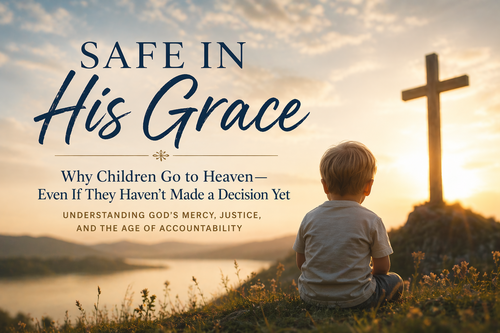
Photo Source: Artificially Generated
Note: If you have any questions about this topic or any of Pastor John's blog articles, feel free to contact him directly at pastor.john@fbcmoriarty.org, or you may contact the church office at office@fbcmoriarty.org.
Few questions weigh more heavily on the heart than this one: What happens to a child (or someone who is cognitively incapable) who dies before they are able to understand and respond to the gospel? This is not merely a theological curiosity—it is a major pastoral concern. It touches grief, hope, and the very character of God. As faithful Christians first, and evangelical Southern Baptists second, we want to answer this question carefully—not with sentimentality or vague reassurance, but with confidence rooted in Scripture and in who God has revealed Himself to be.
The Bible calls us to hold two truths together. First, Scripture is unmistakably clear that all people are sinners by nature. Romans 3:23 reminds us that “all have sinned and fall short of the glory of God,” and Psalm 51:5 makes it even more personal, declaring that sin marks us from conception. This means children are not morally neutral or spiritually innocent in the ultimate sense. They, like every human being, stand in need of salvation through Jesus Christ. However, the second truth is just as clear and just as essential: God is perfectly just and perfectly merciful. Genesis 18:25 asks, “Will not the Judge of all the earth do what is right?” The answer is always yes. God never judges unfairly, never acts unjustly, and never makes a mistake in how He deals with any soul. That leads us to the real question: how does this perfectly just and merciful God apply the saving work of Christ to those who are not capable of conscious faith?
As we read the Bible, a pattern begins to emerge. Accountability is consistently connected to understanding. In Deuteronomy 1:39, children are described as those who “do not yet know good from evil.” Isaiah 7:16 speaks of a time before a child knows how to “refuse evil and choose good.” Even in Jonah 4:11, God expresses compassion for those who “do not know their right hand from their left.” These passages do not teach that children are sinless, but they do show that there is a category of people who lack the capacity for informed moral rebellion. In other words, while they possess a sinful nature, they do not yet possess the developed awareness necessary to consciously reject God in the way an accountable adult can.
One of the clearest narrative glimpses into this issue comes from the life of David. After the death of his infant son, David declares in 2 Samuel 12:23, “I will go to him, but he will never return to me.” What is striking is not only what David says, but how he says it. His grief gives way to settled confidence. He does not speak with uncertainty or hesitation, but with a quiet assurance-- which I believe is linked to the reality that he will one day be reunited with his child. Now, interpreters differ on exactly what David meant. Some understand his words to mean that David expected to be reunited with his child one day in the presence of God. Others take them more narrowly, as a reference to the common reality of death—that David would one day join his son in the grave, while the child would never return to him in this life. That second reading should be acknowledged as a real interpretive possibility. Even so, the tone of the passage (to me) seems to reflect more than mere resignation to mortality. David’s response suggests a deeper trust in the mercy and goodness of God. And whatever position one takes on the verse, David’s hope cannot be grounded in the child’s innocence, because Scripture nowhere teaches that any human being is innocent in that sense. If the verse does imply future reunion, as I believe it does, that hope must rest not on human merit, but on divine mercy. And in that way, we can say this episode reflects David’s trust in the mercy and goodness of God.
This same posture is reinforced by the way Jesus Himself treated children. In Mark 10:14–15, He says, “Let the little children come to me… because the kingdom of God belongs to such as these,” and then immediately adds that anyone who does not receive the kingdom like a child will never enter it. This shows that Jesus is not merely making a statement about children themselves, but using them as a picture of the kind of faith required to enter the kingdom—one marked by humility, dependence, and trust. At the same time, His welcome of children reveals something profound about the heart of God. Children are not pushed aside or treated as spiritually insignificant; they are received, embraced, and held up as examples of those who rightly belong. This does not mean that children are saved apart from Christ or exempt from the need for salvation, but it does show that they are objects of His special compassion and care, and fitting illustrations of those who receive the kingdom by grace.
This is where the theological concept often called the “age of accountability” becomes helpful. While that phrase is not found in Scripture, it serves as a faithful summary of the biblical pattern that moral responsibility is connected to understanding. It refers to a stage of life in which a person comes to understand sin, grasp the gospel, and become responsible for responding in repentance and faith. Before reaching that point, a child, though still possessing a sinful nature, does not bear the same level of moral accountability as someone who knowingly hears and rejects the truth of Christ. This understanding has been widely affirmed in Southern Baptist life. While the Baptist Faith and Message does not explicitly define the eternal state of children, it affirms that God is fatherly in His disposition toward humanity and presents a framework in which accountability is tied to moral awareness. From these truths, along with the broader testimony of Scripture, Southern Baptists have historically concluded that God, in His justice and mercy, graciously applies the saving work of Christ to those who are not yet capable of conscious faith, while firmly maintaining that every person who is saved is saved only through Jesus Christ.
When we bring all of these points together, for me, the conclusion becomes clear and comforting. Children who die are not saved because they are innocent, nor because they have earned salvation in any way. They are saved, like anyone else who is saved, only through the atoning work of Christ. Yet because they have not reached the point of moral accountability—because they are not capable of informed, willful rejection—we trust that God, in His justice and mercy, applies the benefits of Christ’s work to them by grace. This is not a sentimental assumption; it is a theological conviction grounded in the character of God and the testimony of Scripture.
At the same time, this truth should shape how we think about children who are still living. It would be a huge mistake (outright wrong) to conclude that children are automatically saved and therefore need no instruction or urgency. The Bible never encourages that kind of complacency. Instead, children are to be lovingly discipled, taught the Word, and guided toward a genuine, personal faith in Christ. As they grow in understanding, they must respond to the gospel just as every person must. Jesus’ call remains the same: “Repent and believe the good news” (Mark 1:15). Our responsibility is not to force premature decisions, but to faithfully proclaim the gospel and trust the Spirit to bring true conversion in His timing. And lest there be confusion here, yes (absolutely yes), being saved by grace through faith describes the ordinary means of salvation for morally accountable persons. However, this does not require us to conclude that God cannot graciously save infants incapable of such faith, provided that their salvation still rests entirely on Christ’s atonement and not on any kind of personal innocence or merit.
In the end, this issue is not resolved by pinpointing an exact age or drawing rigid lines. Scripture does not give us a number, and that is likely by design. Instead, it directs our attention to something far more reliable—the character of God. When a child dies, we rest not in speculation, but in the certainty that God is both just and merciful. When we raise children, we do so with intentionality, knowing they are moving toward accountability and must one day personally trust Christ. And when questions remain, we anchor our confidence in this truth: God always does what is right, and His mercy is greater than we can fully comprehend.
A simple way to summarize it is this: children are not morally innocent, but they are not yet morally accountable in the same way as those who knowingly reject Christ and understand moral right and wrong. Because God is perfectly just and perfectly merciful, we trust that He graciously applies the work of Christ to those who cannot yet respond in faith. And because that same grace calls all who understand to repentance, we faithfully lead our children to know and follow Him.
Some theological debates aren’t about whether something is true, but about how precisely we should say it so we don’t accidentally say more—or less—than Scripture does. And so, in summary and with humility, I must say that I am fully persuaded that while Scripture does not explicitly define the eternal state of children, it does give us very compelling reasons to trust that God, in His justice and mercy, applies the work of Christ to those who are not yet capable of conscious faith. I realize I am making a big claim here, but I firmly believe it aligns with the historical faith and practice of orthodox Christian theology throughout the ages, with much of historic evangelical and Baptist theology, and, more importantly, is faithful to what the Word of God (i.e., Holy Scripture) teaches. A careful critic might say:
But frankly, that is a debate over precision, not orthodoxy. Therefore, without claiming more than Scripture says yet refusing to say less than it clearly supports, we can rest with confident hope that God, who is perfectly just and abundantly merciful, does what is good and right in every case—and that is enough.
AT A GLANCE:
(Why I Believe Young Children or Someone Who is Cognitively Incapable Goes To Heaven)
The Bible calls us to hold two truths together. First, Scripture is unmistakably clear that all people are sinners by nature. Romans 3:23 reminds us that “all have sinned and fall short of the glory of God,” and Psalm 51:5 makes it even more personal, declaring that sin marks us from conception. This means children are not morally neutral or spiritually innocent in the ultimate sense. They, like every human being, stand in need of salvation through Jesus Christ. However, the second truth is just as clear and just as essential: God is perfectly just and perfectly merciful. Genesis 18:25 asks, “Will not the Judge of all the earth do what is right?” The answer is always yes. God never judges unfairly, never acts unjustly, and never makes a mistake in how He deals with any soul. That leads us to the real question: how does this perfectly just and merciful God apply the saving work of Christ to those who are not capable of conscious faith?
As we read the Bible, a pattern begins to emerge. Accountability is consistently connected to understanding. In Deuteronomy 1:39, children are described as those who “do not yet know good from evil.” Isaiah 7:16 speaks of a time before a child knows how to “refuse evil and choose good.” Even in Jonah 4:11, God expresses compassion for those who “do not know their right hand from their left.” These passages do not teach that children are sinless, but they do show that there is a category of people who lack the capacity for informed moral rebellion. In other words, while they possess a sinful nature, they do not yet possess the developed awareness necessary to consciously reject God in the way an accountable adult can.
One of the clearest narrative glimpses into this issue comes from the life of David. After the death of his infant son, David declares in 2 Samuel 12:23, “I will go to him, but he will never return to me.” What is striking is not only what David says, but how he says it. His grief gives way to settled confidence. He does not speak with uncertainty or hesitation, but with a quiet assurance-- which I believe is linked to the reality that he will one day be reunited with his child. Now, interpreters differ on exactly what David meant. Some understand his words to mean that David expected to be reunited with his child one day in the presence of God. Others take them more narrowly, as a reference to the common reality of death—that David would one day join his son in the grave, while the child would never return to him in this life. That second reading should be acknowledged as a real interpretive possibility. Even so, the tone of the passage (to me) seems to reflect more than mere resignation to mortality. David’s response suggests a deeper trust in the mercy and goodness of God. And whatever position one takes on the verse, David’s hope cannot be grounded in the child’s innocence, because Scripture nowhere teaches that any human being is innocent in that sense. If the verse does imply future reunion, as I believe it does, that hope must rest not on human merit, but on divine mercy. And in that way, we can say this episode reflects David’s trust in the mercy and goodness of God.
This same posture is reinforced by the way Jesus Himself treated children. In Mark 10:14–15, He says, “Let the little children come to me… because the kingdom of God belongs to such as these,” and then immediately adds that anyone who does not receive the kingdom like a child will never enter it. This shows that Jesus is not merely making a statement about children themselves, but using them as a picture of the kind of faith required to enter the kingdom—one marked by humility, dependence, and trust. At the same time, His welcome of children reveals something profound about the heart of God. Children are not pushed aside or treated as spiritually insignificant; they are received, embraced, and held up as examples of those who rightly belong. This does not mean that children are saved apart from Christ or exempt from the need for salvation, but it does show that they are objects of His special compassion and care, and fitting illustrations of those who receive the kingdom by grace.
This is where the theological concept often called the “age of accountability” becomes helpful. While that phrase is not found in Scripture, it serves as a faithful summary of the biblical pattern that moral responsibility is connected to understanding. It refers to a stage of life in which a person comes to understand sin, grasp the gospel, and become responsible for responding in repentance and faith. Before reaching that point, a child, though still possessing a sinful nature, does not bear the same level of moral accountability as someone who knowingly hears and rejects the truth of Christ. This understanding has been widely affirmed in Southern Baptist life. While the Baptist Faith and Message does not explicitly define the eternal state of children, it affirms that God is fatherly in His disposition toward humanity and presents a framework in which accountability is tied to moral awareness. From these truths, along with the broader testimony of Scripture, Southern Baptists have historically concluded that God, in His justice and mercy, graciously applies the saving work of Christ to those who are not yet capable of conscious faith, while firmly maintaining that every person who is saved is saved only through Jesus Christ.
When we bring all of these points together, for me, the conclusion becomes clear and comforting. Children who die are not saved because they are innocent, nor because they have earned salvation in any way. They are saved, like anyone else who is saved, only through the atoning work of Christ. Yet because they have not reached the point of moral accountability—because they are not capable of informed, willful rejection—we trust that God, in His justice and mercy, applies the benefits of Christ’s work to them by grace. This is not a sentimental assumption; it is a theological conviction grounded in the character of God and the testimony of Scripture.
At the same time, this truth should shape how we think about children who are still living. It would be a huge mistake (outright wrong) to conclude that children are automatically saved and therefore need no instruction or urgency. The Bible never encourages that kind of complacency. Instead, children are to be lovingly discipled, taught the Word, and guided toward a genuine, personal faith in Christ. As they grow in understanding, they must respond to the gospel just as every person must. Jesus’ call remains the same: “Repent and believe the good news” (Mark 1:15). Our responsibility is not to force premature decisions, but to faithfully proclaim the gospel and trust the Spirit to bring true conversion in His timing. And lest there be confusion here, yes (absolutely yes), being saved by grace through faith describes the ordinary means of salvation for morally accountable persons. However, this does not require us to conclude that God cannot graciously save infants incapable of such faith, provided that their salvation still rests entirely on Christ’s atonement and not on any kind of personal innocence or merit.
In the end, this issue is not resolved by pinpointing an exact age or drawing rigid lines. Scripture does not give us a number, and that is likely by design. Instead, it directs our attention to something far more reliable—the character of God. When a child dies, we rest not in speculation, but in the certainty that God is both just and merciful. When we raise children, we do so with intentionality, knowing they are moving toward accountability and must one day personally trust Christ. And when questions remain, we anchor our confidence in this truth: God always does what is right, and His mercy is greater than we can fully comprehend.
A simple way to summarize it is this: children are not morally innocent, but they are not yet morally accountable in the same way as those who knowingly reject Christ and understand moral right and wrong. Because God is perfectly just and perfectly merciful, we trust that He graciously applies the work of Christ to those who cannot yet respond in faith. And because that same grace calls all who understand to repentance, we faithfully lead our children to know and follow Him.
Some theological debates aren’t about whether something is true, but about how precisely we should say it so we don’t accidentally say more—or less—than Scripture does. And so, in summary and with humility, I must say that I am fully persuaded that while Scripture does not explicitly define the eternal state of children, it does give us very compelling reasons to trust that God, in His justice and mercy, applies the work of Christ to those who are not yet capable of conscious faith. I realize I am making a big claim here, but I firmly believe it aligns with the historical faith and practice of orthodox Christian theology throughout the ages, with much of historic evangelical and Baptist theology, and, more importantly, is faithful to what the Word of God (i.e., Holy Scripture) teaches. A careful critic might say:
- “You’re inferring more than Scripture explicitly states.”
- “You should say ‘we have good reason to hope’ instead of ‘they are saved.’”
But frankly, that is a debate over precision, not orthodoxy. Therefore, without claiming more than Scripture says yet refusing to say less than it clearly supports, we can rest with confident hope that God, who is perfectly just and abundantly merciful, does what is good and right in every case—and that is enough.
AT A GLANCE:
(Why I Believe Young Children or Someone Who is Cognitively Incapable Goes To Heaven)
- They are sinners by nature (Romans 3:23, 5:12, Psalm 51:5)
→ They still need Christ (Acts 4:12) - They have not reached moral accountability
→ They are not judged on the basis of willful, informed rejection of revealed truth
(I am not saying that ignorance excuses adults who reject or neglect the truth God has given them. Because Scripture suggests that accountability is connected to knowledge and understanding, and that judgment corresponds to light received. Scripture also teaches that all people have received some light through creation, conscience, and God’s moral law written on the heart. But infants and very young children are different. They have not yet developed the capacity for moral understanding necessary to knowingly reject God’s revealed truth. They do not sin with the same conscious, willful rebellion as those who understand God’s command and deliberately turn away from it. An infant lacks developed moral comprehension. An adult without the gospel may lack special revelation about Christ, but he still has general revelation. And Romans 1:19–20 says that what can be known about God is evident because God has shown it through creation, so people are “without excuse.” Romans 2:14–15 says that even Gentiles without the written law show that the work of the law is written on their hearts, while their conscience bears witness. So a remote tribesman in a Jungle who has never heard the gospel is not judged for rejecting a sermon about Jesus he never heard. He is judged according to the light he did have—and Scripture says fallen humanity suppresses that light, distorts worship, violates conscience, and sins against God and is without excuse. Infants/young children, however, have not yet developed the moral understanding necessary for the suppression/rejection of God’s revealed truth. Consider Luke 12:47–48, Romans 4:15, 5:13, 7:9, Deuteronomy 1:39, John 15:22, James 4:17, Acts 17:30, Matthew 11:21–24) - God is gracious, just, and merciful (Genesis 18:25, Deuteronomy 32:4, Psalm 86:15, 103:8, 145:9, Joel 2:13)
→ He does what is right in every case. Our confidence is in his unchanging character, not in human speculation. - Christ’s atonement is sufficient (Romans 5:18, Ephesians 2:8-9, John 1:13)
→ Applied by grace through faith in Christ, not human abilities or works
"Jesus answered and said to him, “Truly, truly, I say to you, unless one is born again he cannot see the kingdom of God.” -- John 3:3
Have you been born again? The Bible says all have sinned and fallen short of the glory of God and that the wages of sin is death. However, there is Good News! The Bible also says that the free gift of God is eternal life in Christ Jesus our Lord (Romans 3:23 and 6:23). Is Jesus Christ your personal Lord and Savior? If not, why not?
Have you been born again? The Bible says all have sinned and fallen short of the glory of God and that the wages of sin is death. However, there is Good News! The Bible also says that the free gift of God is eternal life in Christ Jesus our Lord (Romans 3:23 and 6:23). Is Jesus Christ your personal Lord and Savior? If not, why not?
Recent
Was the Apostle Paul a False Teacher? Why Christians Must Reject This Dangerous Deception
October 14th, 2026
A Faith That Does Not Shrink Back
September 22nd, 2026
Can I be Angry at God?
September 5th, 2026
Why Church Membership Matters
July 29th, 2026
What Are the Apocryphal 'Gospels?'
July 1st, 2026
Archive
2026
March
April
2025
April
September
October
2024
February
April
July
December
2023